

Profit in Months, Not Years. What 100 CFO Engagements Reveal About Scale-up Financial Fitness | Rule of 40 | Ep. 4
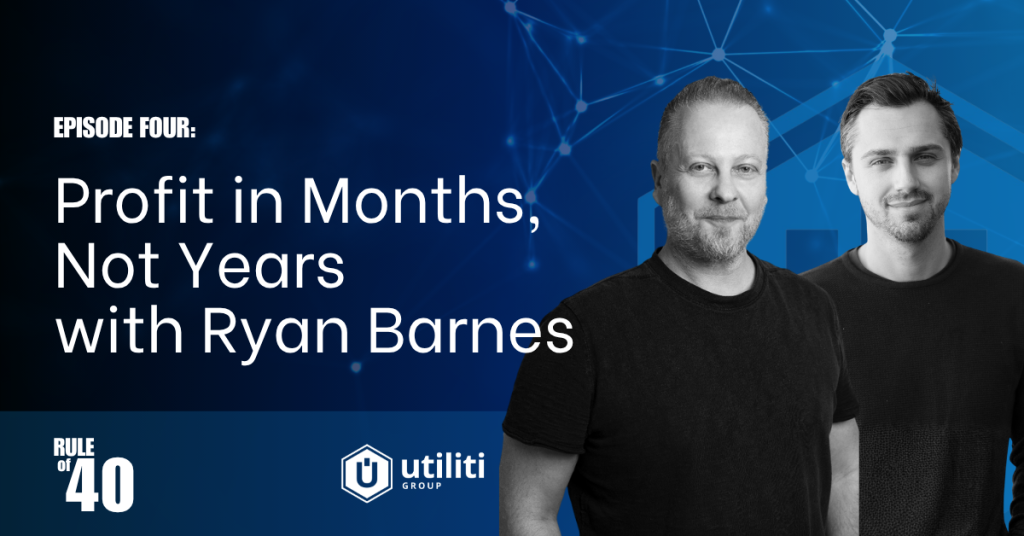
Profit in Months, Not Years. What 100 CFO Engagements Reveal About Scale-up Financial Fitness
Rule of 40, Episode 4 with Ryan Barnes, Managing Partner, TWIYO
Growth can feel like momentum. But momentum without financial control is not steering — it is a crash waiting to happen. Ryan Barnes, Managing Partner of TWIYO Capital & Advisory, has worked at CFO level with more than 100 businesses across sectors. He knows what the warning signs look like before most founders do.
That is the central argument Ryan brings to Rule of 40, Episode 4. His firm has completed more than 100 CFO engagements across sectors, and what he keeps seeing is the same set of problems playing out in the same order. The conversation covers what those problems are, why they persist even in well-run companies, and what founders need to do differently to build a business that can stand on its own.
Finance as an afterthought
“Finance is the poor cousin in the entire business operation,” Ryan says. Founders often reach significant revenue before they have visibility into their balance sheet, cash conversion cycle, or the real cost of a customer. By the time the numbers become urgent, the problems are already embedded.
Sales gets headcount. Product gets roadmap. Marketing gets budget. Finance gets a part-time bookkeeper. The practical consequence is that founders are flying without instruments — they know they are growing, but they cannot tell you whether that growth is creating value or consuming it.
The balance sheet no one reads
“No one runs the balance sheet,” Ryan says. “No one thinks about deferred revenue.”
This is where a lot of damage accumulates quietly. Deferred revenue looks like cash until it is not. Receivables age out. Liabilities compound. A business can have a strong revenue line and a fragile financial structure underneath it. Founders who are not reading the balance sheet regularly will not see it until a liquidity event forces the conversation.
The cost of the next raise
In a higher-rate, more sceptical market, the assumption that there will always be another round on acceptable terms is no longer reliable.
“You have to prove to yourself and the market that you can run without external capital,” Ryan says. That does not mean refusing to raise. It means building a business that does not depend on the next round to survive.
When to push on growth
“It’s not grow at all costs. It’s grow with discipline,” Ryan says.
There are times when going hard on growth is exactly the right call — when the market is open, the model is proven, and speed creates a defensible position. The discipline is in knowing which phase you are in. Growth-phase decisions made in a consolidation environment cost founders dearly.
Getting the financial setup right early
Ryan’s advice for founders in years one to three: proper accounting from the start, a cash flow model that is actually used, and someone senior enough to challenge the numbers — whether that is a fractional CFO, a board member with financial depth, or a trusted external advisor.
The cost of getting this right early is low. The cost of retrofitting it later, when the business is complex and under pressure, is significant.
Listen now
Watch on YouTube:
Listen on Spotify:
Listen on Apple Podcasts: